Tax Year 2026-27
★ New Income Tax Act 2025
Tax Saving Options: Old Regime vs New Regime
Updated guide under the New Income Tax Act 2025 — choose the right regime and save more this Tax Year
📋 New Terminology Under Income Tax Act 2025
The concept of “Previous Year” and “Assessment Year (AY)” has been abolished. The new act introduces a single unified concept: “Tax Year (TY)” — the year in which income is earned is the same year it is assessed and taxed.
The concept of “Previous Year” and “Assessment Year (AY)” has been abolished. The new act introduces a single unified concept: “Tax Year (TY)” — the year in which income is earned is the same year it is assessed and taxed.
| Old Terminology (Income Tax Act 1961) | New Terminology (Income Tax Act 2025) |
| Previous Year 2026-27 + Assessment Year 2027-28 | Tax Year 2026-27 |
| Financial Year (FY) | Tax Year (TY) |
| Assessment Year (AY) | ✘ Abolished |
📢 Important: The New Income Tax Act 2025 is effective from Tax Year 2026-27 (April 1, 2026), replacing the Income Tax Act 1961. Sections are now renumbered as “Clauses.” Throughout this guide, old section references are shown in brackets for easy cross-reference. Always verify clause numbers with the official IT Act 2025 text or consult your CA.
Tax Year 2026-27 is the first year under India’s new Income Tax Act 2025. Under the new regime, income up to ₹12.75 lakh is effectively zero tax (combining the ₹12L rebate with the ₹75,000 standard deduction). Here’s everything you need to make a smart, informed decision.
Understanding the Two Regimes
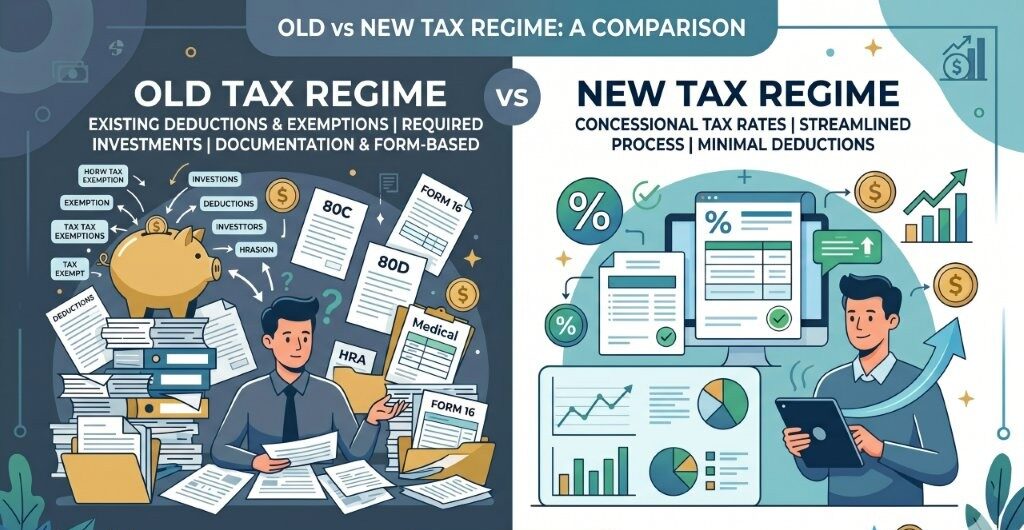
🏭 Old Tax Regime
- Traditional tax slabs with 70+ deductions
- Standard Deduction: ₹50,000
- Best for heavy investors (> ₹7.5L deductions)
- Requires submission of investment proofs
✨ New Tax Regime
- Lower tax rates; most deductions unavailable
- Standard Deduction: ₹75,000
- Default regime under Income Tax Act 2025
- Zero tax up to ₹12.75L effective
Tax Slabs — Tax Year 2026-27
| Income Slab | Tax Rate |
|---|---|
| Up to ₹4,00,000 | Nil |
| ₹4,00,001 – ₹8,00,000 | 5% |
| ₹8,00,001 – ₹12,00,000 | 10% |
| ₹12,00,001 – ₹16,00,000 | 15% |
| ₹16,00,001 – ₹20,00,000 | 20% |
| ₹20,00,001 – ₹24,00,000 | 25% |
| Above ₹24,00,000 | 30% |
* Enhanced rebate: Zero tax if income ≤ ₹12,00,000 (Clause 158). Standard deduction: ₹75,000.
* Above data is excluding Surcharge on Income Tax and Health & Education Cess.
| Income Slab | Tax Rate |
|---|---|
| Up to ₹2,50,000 | Nil |
| ₹2,50,001 – ₹5,00,000 | 5% |
| ₹5,00,001 – ₹10,00,000 | 20% |
| Above ₹10,00,000 | 30% |
* Standard Deduction: ₹50,000. Rebate: Zero tax if income ≤ ₹5,00,000.
* Above data is excluding Surcharge on Income Tax and Health & Education Cess.
Key Deductions: Old Regime vs New Regime
Under the IT Act 2025, “Sections” are now “Clauses.” Old section numbers (IT Act 1961) are shown in brackets below for reference. Note: “Tax Year” replaces both “Previous Year” and “Assessment Year” throughout the new act.
| Deduction / Exemption | Max Limit | Old Regime | New Regime |
|---|---|---|---|
| Standard DeductionClause 63C (old Sec 16(ia)) | ₹75,000 | ✔ Yes | ✔ Yes |
| Investments: PPF, ELSS, LIC, EPF, NSC, etc.Clause 123 (old Sec 80C) | ₹1,50,000 | ✔ Yes | ✘ No |
| Health Insurance PremiumClause 126 (old Sec 80D) | ₹25,000–₹1,00,000 | ✔ Yes | ✘ No |
| HRA ExemptionClause 63A (old Sec 10(13A)) | Actual / Formula | ✔ Yes | ✘ No |
| NPS – Additional Self ContributionClause 125(1B) (old Sec 80CCD(1B)) | ₹50,000 | ✔ Yes | ✘ No |
| NPS – Employer ContributionClause 125(2) (old Sec 80CCD(2)) | 14% of salary (Govt in both regime) | ✔ Yes (14%) | ✔ Yes (10%) |
| Home Loan Interest – Self OccupiedClause 71(b) (old Sec 24(b)) | ₹2,00,000 | ✔ Yes | ✘ No |
| Leave Travel Allowance (LTA)Clause 63B (old Sec 10(5)) | Actual (2 journeys / 4 Tax Years) | ✔ Yes | ✘ No |
| Savings Account InterestClause 130 (old Sec 80TTA) | ₹10,000 | ✔ Yes | ✘ No |
| Donations to Approved InstitutionsClause 133 (old Sec 80G) | 50%–100% | ✔ Yes | ✘ No |
| Education Loan InterestClause 128 (old Sec 80E) | Actual interest (8 Tax Years) | ✔ Yes | ✘ No |
| Person with DisabilityClause 134 (old Sec 80U) | ₹75,000–₹1,25,000 | ✔ Yes | ✘ No |
Break-even for Tax Year 2026-27: Given the revised new regime slabs and ₹12L rebate, the old regime saves more only when total eligible deductions exceed approximately ₹7.5 Lacs–₹7.75 Lacs. Below this threshold, the new regime is typically more beneficial.
Who Should Choose Which Regime?
🏭 Choose Old Regime if you…
- Max out investments — ₹1.5L (Cl. 123)
- Pay home loan & claim interest (Cl. 71(b))
- Receive HRA & live on rent (Cl. 63A)
- Pay health insurance premiums (Cl. 126)
- Invest additionally in NPS (Cl. 125(1B))
- Total deductions exceed ₹7.5L+
- Income above ₹15L with all deductions claimed
✨ Choose New Regime if you…
- Earn up to ₹12.75L — effectively zero tax!
- Are new to career with few investments
- Don’t have a home loan or live on rent
- Want simple filing — no proofs needed
- Total deductions are less than ₹7.5L
- Want lower TDS deducted each month
- Prefer flexibility over tax planning
🎯 Find Your Best Regime
1. What is your annual income?
2. Is your total deduction (PF/NPS/LIC/HRA/Loan/etc.) more than ₹7.5 Lacs?
Important under IT Act 2025: Salaried employees can switch regimes every Tax Year at the time of filing their return. Those with business or professional income can switch only once. The New Regime is the default — you must explicitly opt for the Old Regime with your employer (via Form 12BB) or in your ITR. There is no longer any concept of a separate “Assessment Year” — your return is filed for the Tax Year itself.
Let Our CA Calculate Your Exact Tax Savings
We’ll compare both regimes for Tax Year 2026-27 based on your specific income, investments, and deductions under the new IT Act 2025 — and tell you exactly which saves you more.
Book a Free Consultation →